
Forestry Mulching in Suffolk, VA
Forestry mulching fits Suffolk land well. One tracked machine grinds brush and small trees into a mulch layer where they stand. The roots stay to hold soft ground together, and nothing has to be burned, which matters in a city that bans burning from May through September. Here's how it works, where it's the right tool on Suffolk's flat, wet ground, where it isn't, what it costs, and when the city may still want a permit.
How it works
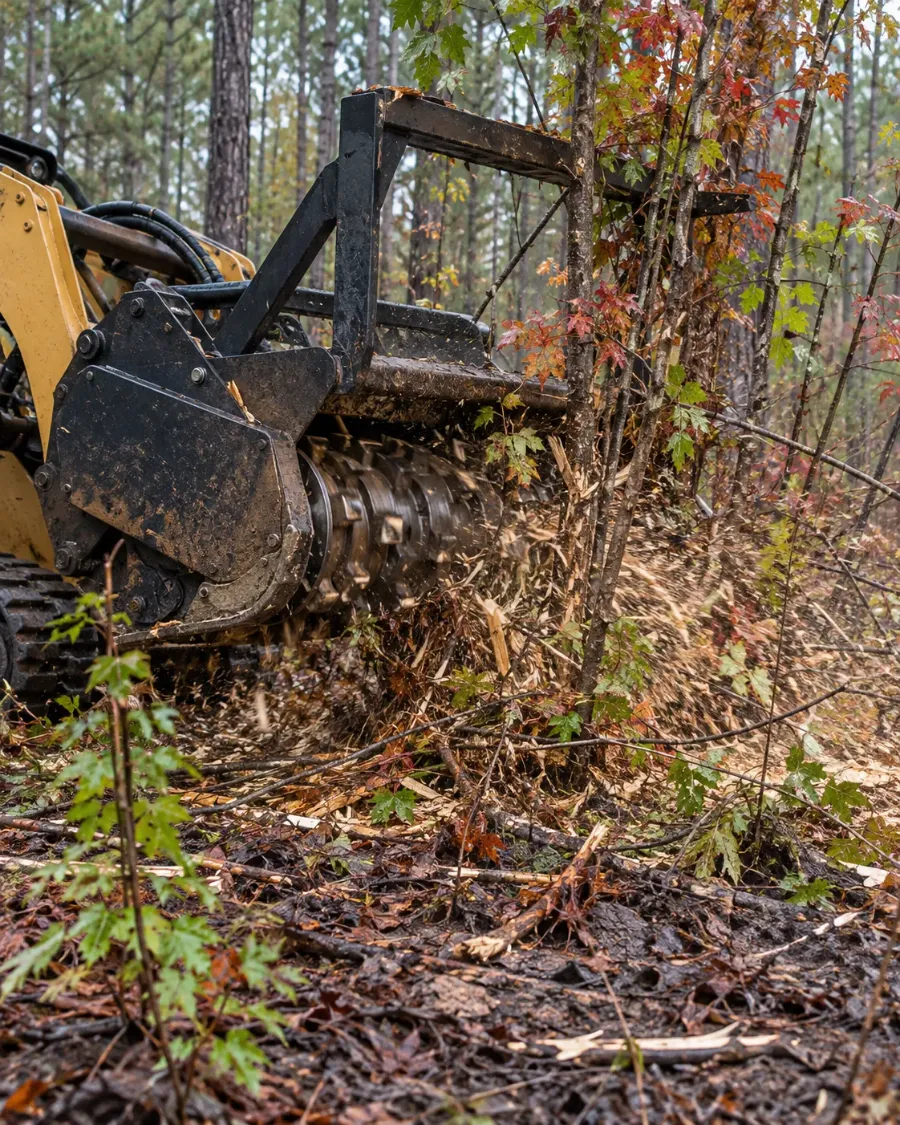
A forestry mulcher is a drum lined with steel or carbide teeth, mounted on a compact track loader, a skid steer, an excavator arm, or a dedicated tracked carrier. The operator drives into standing growth and the head shreds it from the top down. The chips fall where they are as a mulch layer. No crew cutting ahead, no piles, no chipper, no trucks: one operator and one machine, in one pass.
Virginia Cooperative Extension's woodland clearing guide puts the practical limit for most mulching heads at stems about 6 to 8 inches across. Smaller heads on a standard skid steer take less, and bigger heads on high-flow or purpose-built machines take more at a higher hourly rate. Bigger trees get cut with a saw and mulched in pieces, or the job becomes conventional clearing. Ask each contractor what diameter their machine handles comfortably.
Why it suits Suffolk ground
By our tally of USDA soil survey data, about half of Suffolk is mapped as poorly drained and nearly three-quarters lies on slopes under 2 percent. On that kind of ground, the less the soil gets torn up, the better:
- Roots stay in. Nothing is pulled out of the ground, so there are no stump holes to fill with water and the soil keeps its structure. Extension calls mulching the lowest-erosion way to clear.
- The mat helps. A tracked machine on its own mulch layer carries better than wheeled equipment on bare ground. It still has limits; see clearing wet ground.
- No burning. Suffolk bans open burning May through September, and land-clearing burns need a permit and a 500-foot setback the rest of the year. Mulching leaves nothing to burn.
- Keepers stay. An operator can work around individual oaks, pines, or a tree line without cutting their roots.
Typical mulching jobs around Suffolk
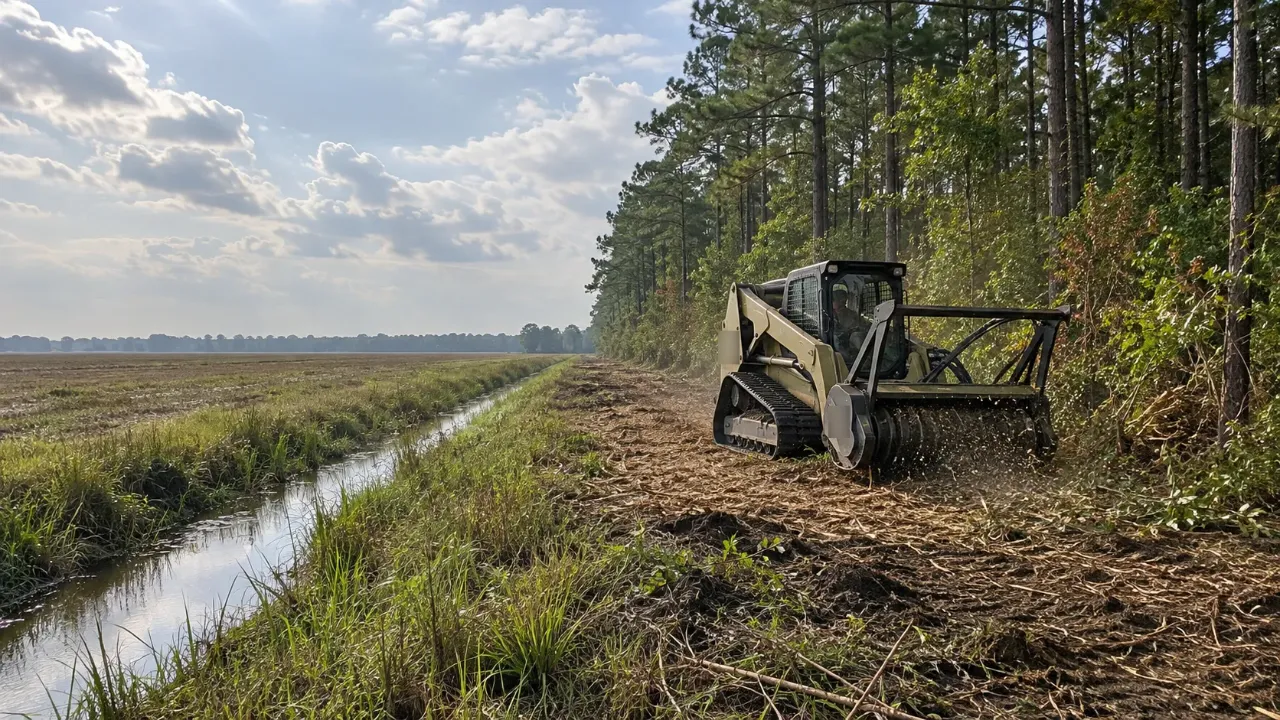
- Clearing field edges, fence lines, and ditch banks that have grown up in sweetgum, pine, and briars.
- Cleaning up cutover after a timber harvest: slash, leftover small trees, and regrowth.
- Trails, lanes, shooting lanes, and food plots on hunting land.
- Thinning the understory of woods while leaving the big trees.
- Clearing most of a wooded homesite before the footprint is grubbed.
- Knocking back invasives such as privet, Japanese honeysuckle, and multiflora rose, all ranked high-threat in Virginia's coastal region on the state's invasive plant list.
- Firebreaks around buildings and along woods.
When it's the wrong tool
- Under anything you'll build. Roots left in the ground rot and settle. A house pad, slab, driveway base, or drainfield needs stumps and roots grubbed out. Mulch the acreage; grub the footprint.
- Big timber. Mature pine and hardwood are beyond a mulcher, and on a real stand may be worth selling first.
- Inside the RPA buffer without approval. Within 100 feet of tidal water, marsh, or a year-round stream, removing trees, shrubs, or groundcover needs City Planning approval and replanting, whatever machine does it.
- Saturated muck. Even tracked machines sink in organic soils when they're wet. Expect to wait for a dry stretch.
- When you need bare soil now. Seed won't reach soil through deep mulch until it's raked off or breaks down.
Regrowth
Mulching cuts trees; it doesn't kill the hardwoods. The U.S. Forest Service's species guides describe sweetgum regenerating from root sprouts and red maple sprouting within two to six weeks of cutting, and Extension warns that hardwood stumps resprout unless treated promptly. Pines don't resprout from a cut stump, though new seedlings blow in. Plan on bush-hogging the sprouts in the first year or two, a herbicide follow-up for the worst species, or both. Ask whether the contractor treats stumps as they go. Near the water, keep herbicide out of the RPA buffer unless the city has approved it.
What forestry mulching costs
Mulching is quoted per acre, per day, or per machine hour. HomeAdvisor's June 2026 figures run $400 to $1,500 per acre and $125 to $400 an hour depending on density; Angi's May 2026 figures run $1,000 to $2,500 per acre at $150 to $300 an hour. A study cited by Extension found mulching at roughly half the cost of conventional clearing. What moves the number in Suffolk: stem size and density, wet ground and weather days, how far the machine travels, the minimum charge on small jobs, and how carefully the operator has to work around keepers. Those are national figures, not Suffolk quotes. More on cost.
Does mulching need a permit in Suffolk?
It might. Suffolk's land disturbance rules start at 2,500 square feet inside the Chesapeake Bay Preservation Area and 10,000 outside it. City Code defines land disturbance around soil erosion and runoff, including "clearing," but the Unified Development Ordinance's definition reaches "vegetation on the land surface through vegetation clearing." Nothing official says how mulching that leaves roots in place is treated. For a job of any size, ask Public Works Engineering ((757) 514-7611) first, and get the answer in writing. Clearing for bona fide agriculture is exempt, and in the RPA buffer, Planning approval is needed regardless. The permits guide has the details.
Forestry mulching questions
Will the mulch hurt my field?
Thin mulch breaks down into the soil and grass comes through. Deep mulch ties up nitrogen as it decomposes, so seed struggles until it's raked, disked, or given a season. A soil test tells you how much lime and fertilizer the ground needs.
Can you work around the timber I want to keep?
Yes. Flag the keepers and agree how close the operator will work. Mulching leaves their roots alone.
How many acres a day?
Extension's rule of thumb is one to eight hours of machine time per acre, depending on density. Thin brush goes fast; a thick stand of sweetgum doesn't, and wet ground slows everything.
Should I cut the trees down first?
Usually not. Mulchers work best on standing growth; fallen trunks lying every which way slow the job. Ask the contractor before you pick up a saw.
How we help
Call or send a short request with where the land is, roughly how much, and what's growing on it. We connect you with one independent contractor who runs mulching equipment in your part of Suffolk. They walk the land and give you a quote, and you decide. There's no charge for the referral.
Want a local contractor to walk your land?
Call or send a short request. There's no charge for the referral.