
Brush Clearing for Fields, Ditch Banks & Hunting Land in Suffolk, VA
Suffolk is still farm country: the 2022 Census of Agriculture counted 231 farms on about 71,000 acres, mostly soybeans, cotton, corn, peanuts, and wheat. Field edges creep in, ditch banks fill with brush, idle ground goes to sweetgum and briars, and hunting tracts need lanes and plots. Here's how brush clearing gets done here, what grows back, how the Bay Act's farm rules fit in, and what it costs.
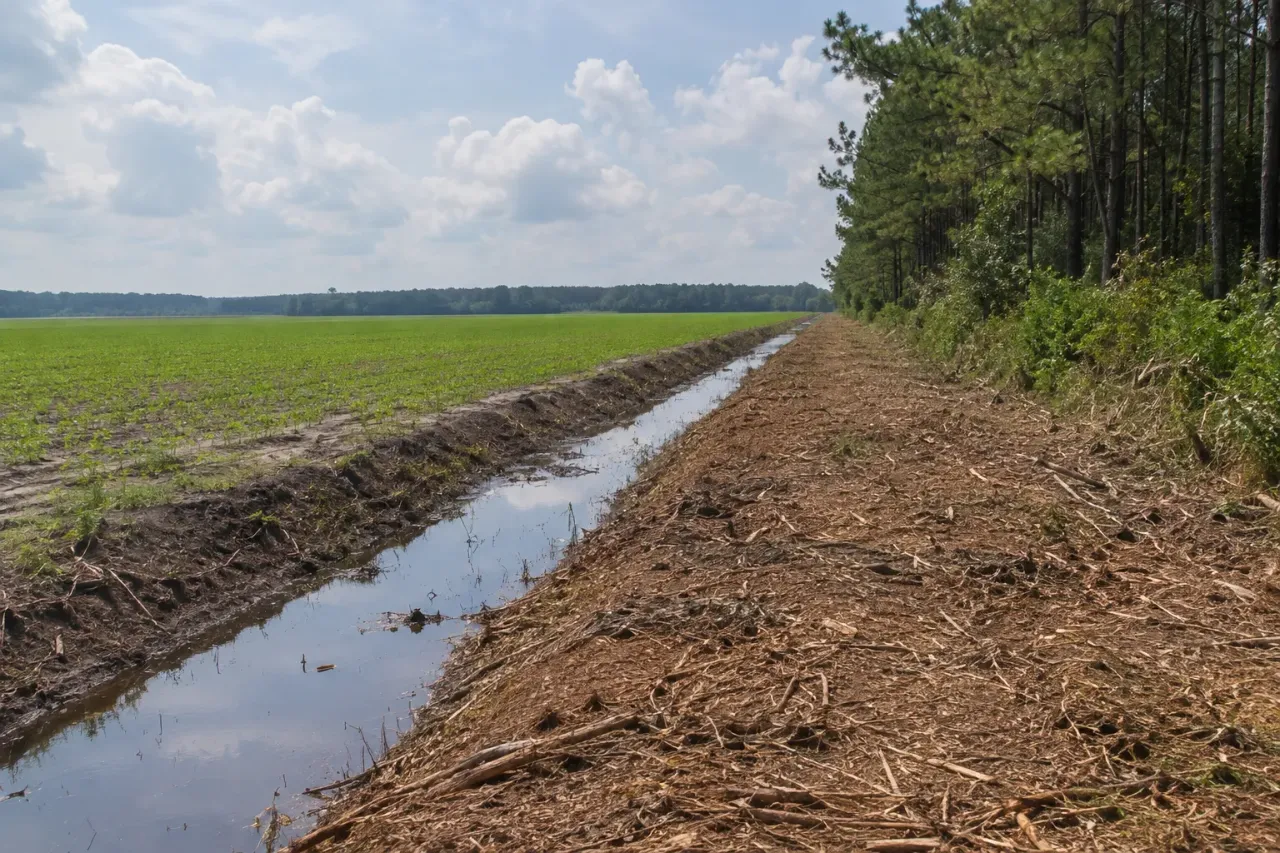
Match the method to the growth
- Bush-hogging. A tractor and rotary cutter handles weeds, briars, and stems up to an inch or two. If it's just grown up for a season or two, this is all it needs and it's the cheapest option.
- Forestry mulching. Once sweetgum, pine, and wax myrtle have real trunks, a mulcher grinds them in place, leaves roots to hold the ditch bank or field edge, and leaves nothing to burn. It's the workhorse for field edges, fence lines, ditch banks, and anything grown up past bush-hog size.
- Clearing and grubbing. Only when trees are too big to mulch or the ground has to be bare and stump-free for plowing. More cost, more soil disturbance, and debris to deal with.
- Hand crew and chipper. For tight spots, around buildings, and anywhere a machine shouldn't go, such as the edge of a wetland or the RPA buffer.
Common Suffolk brush jobs
- Field edges where the woods have crept in and shade the outside rows.
- Ditch banks, which on flat Suffolk ground carry the water off the fields and fill with brush that slows the flow. Clearing the bank is routine; deepening a ditch or draining a wet area can need wetland permits.
- Fence lines and farm lanes.
- Hunting land: trails, shooting lanes, and food plots cut out of thick woods or old cutover.
- Idle ground being brought back into a field or pasture.
- Firebreaks along woods and around outbuildings.
What grows back
Cutting brush doesn't kill most of it. On coastal Virginia ground, the usual suspects:
- Sweetgum regenerates from root sprouts after cutting, per the U.S. Forest Service's species guide, so one cut tree becomes a cluster of new stems.
- Red maple sprouts from the stump within weeks of cutting, per the Forest Service.
- Loblolly pine doesn't resprout from a cut stump, but seedlings blow in from nearby stands.
- Invasives. The Department of Conservation and Recreation's invasive plant list ranks Japanese honeysuckle, Chinese privet, kudzu, multiflora rose, autumn olive, tree-of-heaven, common reed (phragmites), and Johnson grass as high-threat in Virginia's coastal region. Virginia Cooperative Extension's tree-of-heaven guide says cutting alone won't kill it.
The plan that works: clear when the ground is firm, treat the species that need it, mow before the sprouts get woody in the first and second summers, and keep a normal mowing schedule after that. Skip the follow-up and you'll be paying for the same job again in three years.
Farm clearing, the Bay Act, and permits
Suffolk's erosion and stormwater ordinance exempts "clearing of lands specifically for bona fide agricultural purposes," along with tilling, planting, and harvesting crops (City Code § 35-6). Reclaiming a field or pasture for real farm use generally fits.
The Chesapeake Bay Act treats farms differently from forestry. Inside Suffolk's Preservation Area, the ordinance requires a soil and water quality conservation assessment for farmland, with plans approved by the Peanut Soil and Water Conservation District Board, and it requires the agricultural buffer along water to be managed so runoff doesn't cut through it and noxious weeds stay out. The state regulation lets farms encroach into the landward part of the 100-foot buffer when certain conservation practices are in place, but Suffolk's ordinance text doesn't spell out those reductions, so ask the city's Planning Division (757-514-4060) or the Peanut Soil and Water Conservation District before clearing near water. Outside agriculture, removing vegetation in the RPA buffer needs Planning approval and replanting. More on the buffer.
Burning the brush is limited to October through April in Suffolk, with a Fire Marshal permit and a 500-foot setback from occupied buildings. From May through September, mulch it.
What brush clearing costs
"Brush" covers everything from tall weeds to a sweetgum thicket, so national guides disagree. HomeGuide's late-2025 figures put brush clearing at $800 to $3,000 per acre; Lawn Love's run $330 to $630; HomeAdvisor's and Angi's 2026 numbers for light brush go as low as $20 to $200 per acre, which is bush-hog territory. Mulching real woody growth falls in the mulching ranges on the cost page. Field-edge and ditch-bank work is often priced by the hour or the day, and the per-acre cost drops as the job gets bigger because the trip out to the farm is spread over more ground.
Brush questions
Can I just bush-hog it?
If the biggest stems are thumb-sized, yes. Once there are trunks the cutter bounces off of, it's a mulching job. Mulch once, then bush-hog from then on.
Can you clear the ditch along my field?
Clearing brush off the banks, yes. If the work turns into digging, deepening, or draining a wet area, check first whether wetland permits apply.
When is the best time of year?
Whenever the ground is firm enough. Winter work means better visibility and dormant snakes; summer and fall are often drier. If you want to burn, it has to be October through April.
Can you cut lanes and food plots on my hunting land?
That's classic mulching work: a mulcher cuts a lane in one pass and leaves the plot ready to disk. Flag the routes and the trees you want left for cover.
How we help
Call or send a short request with where the land is, roughly how many acres, and what's grown up on it. We connect you with one independent contractor who does this work in your part of Suffolk. They walk it and give you a quote, and you decide. There's no charge for the referral.
Want a local contractor to walk your land?
Call or send a short request. There's no charge for the referral.