
Land Clearing Permits, Bay Act Buffers & Burn Rules in Suffolk, VA
Do you need a permit to clear land in Suffolk? More often than in most of Virginia. Suffolk is a Chesapeake Bay Act city, so in much of it the permit line is 2,500 square feet, not 10,000. Land near tidal water carries a protected 100-foot buffer, tidal marsh has its own board, and nothing can be burned from May through September. Here's each rule in plain terms, with the thresholds, the fees the city publishes, and the offices that decide. Checked against the Suffolk City Code, the Unified Development Ordinance, and state law in October 2026. Rules change, so the links are there for a reason.
The short version
| If you're... | Then... |
|---|---|
| Disturbing 2,500 sq ft or more inside the Chesapeake Bay Preservation Area | City erosion and sediment control plan (or, for a single-family house, an agreement in lieu of a plan) and a land disturbance permit from Public Works. |
| Disturbing 10,000 sq ft or more outside it | The same plan or agreement and permit. The Preservation Area doesn't cover the whole city; southern Suffolk is outside it. |
| Disturbing one acre or more | The full state stormwater criteria and state construction permit coverage on top of the city permit. |
| Cutting anything within 100 feet of tidal water, tidal wetlands, connected wetlands, or a stream that runs year-round | That's the RPA buffer. Removing trees, shrubs, or groundcover there needs City Planning approval and replanting, at any size. |
| Working in tidal marsh or shoreline | Suffolk Wetlands Board permit, applied for through the joint federal and state application. |
| Clearing strictly for farming | Exempt from the city land disturbance permit. Inside the Preservation Area, farms need a soil and water quality conservation assessment through the Peanut Soil and Water Conservation District. |
| Harvesting timber | Exempt only if the land is replanted or converted to farm or pasture. The logger notifies the Department of Forestry, and Virginia's seed tree law can apply to pine. |
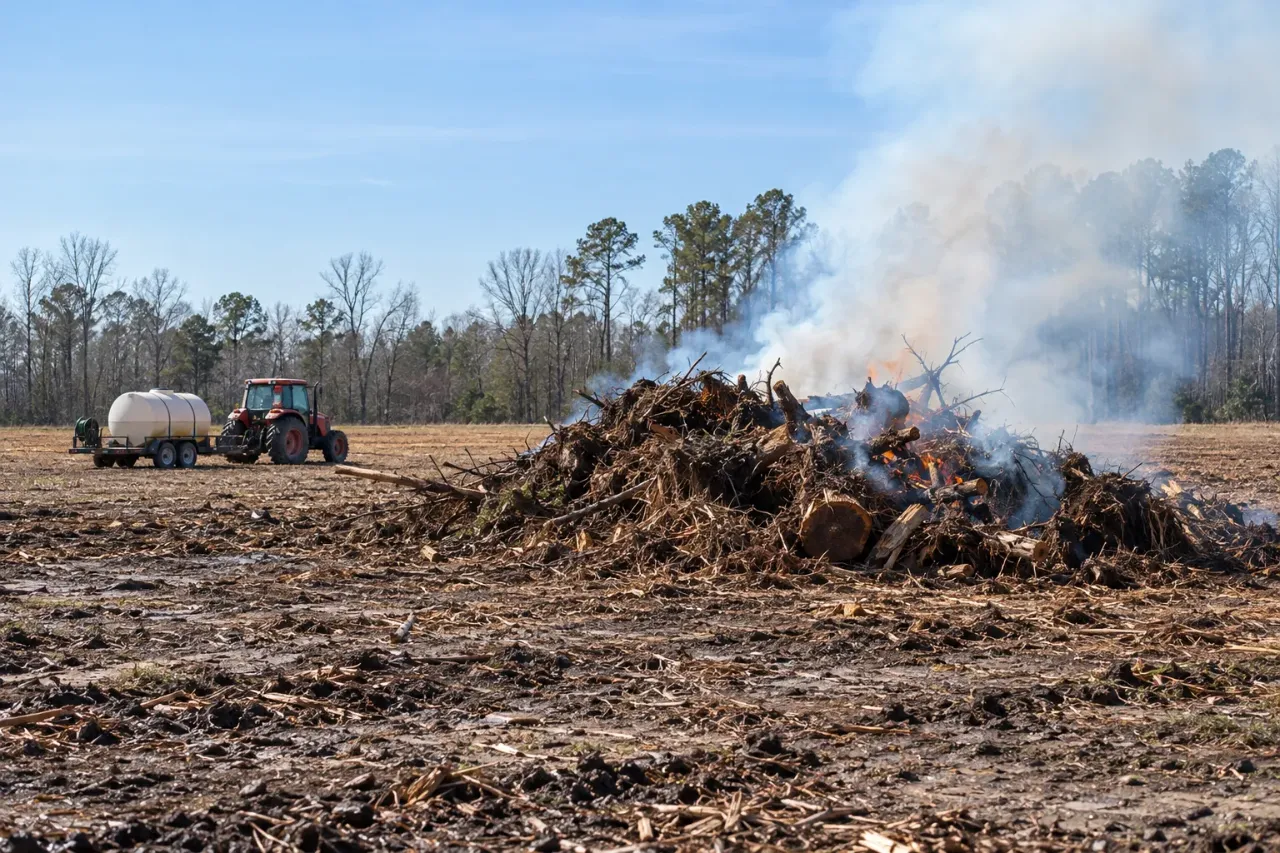
| Burning the debris | Fire Marshal permit, 500 feet from occupied buildings, and only October through April. No open burning of any kind May 1 to September 30. |
First question: is your land in the Chesapeake Bay Preservation Area?
Suffolk is one of the "Tidewater Virginia" localities named in the Chesapeake Bay Preservation Act (Va. Code § 62.1-44.15:68), and it adopted its Bay overlay district in 1990. The overlay has two parts. The Resource Protection Area (RPA) is the sensitive land along the water: tidal wetlands, tidal shores, non-tidal wetlands connected to them or to streams that flow year-round, and a 100-foot buffer landward of all of those. The Resource Management Area (RMA) is everything else that drains to the Bay. In the city's words, the RMA "includes all land outside of the RPA that is within the Chesapeake Bay watershed" (City of Suffolk).
That last part matters, because not all of Suffolk drains to the Bay. The city's own septic FAQ says properties outside the Preservation Area are "in the southern portion of the City." If any part of a lot falls inside the Preservation Area, the whole lot has to comply (UDO § 31-415). The city's maps are general; for a single-family house, the Planning Director can draw the exact lines instead of requiring an environmental study. To find out where your property stands, call the Planning Division at 757-514-4060.
The city's land disturbance permit
Suffolk rewrote its erosion and stormwater rules as City Code Chapter 35, the Erosion and Stormwater Management Ordinance, in July 2025. Under § 35-4, the rules reach land disturbance of 10,000 square feet or more outside the Preservation Area, 2,500 square feet or more inside it, any smaller job that's part of a larger development plan of an acre or more, and the full state stormwater criteria at one acre. The Bay overlay adds that the 2,500 square foot line includes "construction of single-family houses and installation of septic drain fields," and that inside the Preservation Area "a grading permit will be required prior to any clearing or cutting associated with the proposed development."
No land disturbance may start until the plan (or agreement), the application, and the name of a certified Responsible Land Disturber are in and Public Works has issued approval. The city's permit application says Public Works must be told at least 48 hours before work starts, and that work can't begin until the sediment controls on the plan are in place. Willful or negligent violations carry fines of $2,500 to $32,500 under § 35-16.
House sites. For a single-family house, the city accepts an agreement in lieu of a plan. Its form calls for silt fence behind the curb line and on every side that slopes off the lot, trenched in at least 4 inches; streets kept clean of sediment; inlet protection; a construction entrance; and all bare ground stabilized "within seven (7) days of final grading." The city's forms page has the single-family packet, and the city lists a $290 plan review fee for a single-family lot, paid to the Treasurer. Other plan review fees run from $460 under 10,000 square feet to $1,585 for half an acre to an acre, plus $250 per acre above that, per the Public Works fee form revised September 2025.
Exemptions. City Code § 35-6(c) exempts minor homeowner work such as gardens, landscaping, repairs, and maintenance; fence posts and poles; and "clearing of lands specifically for bona fide agricultural purposes" along with growing and harvesting crops. Timber harvesting is exempt only if the land is reforested or turned into farm or improved pasture. Septic lines and drainfields are exempt unless they're part of the overall plan for the house they serve.
Who to call. Public Works Engineering, (757) 514-7611. The Public Works main line is 757-514-4355.
Does forestry mulching count as land disturbance in Suffolk?
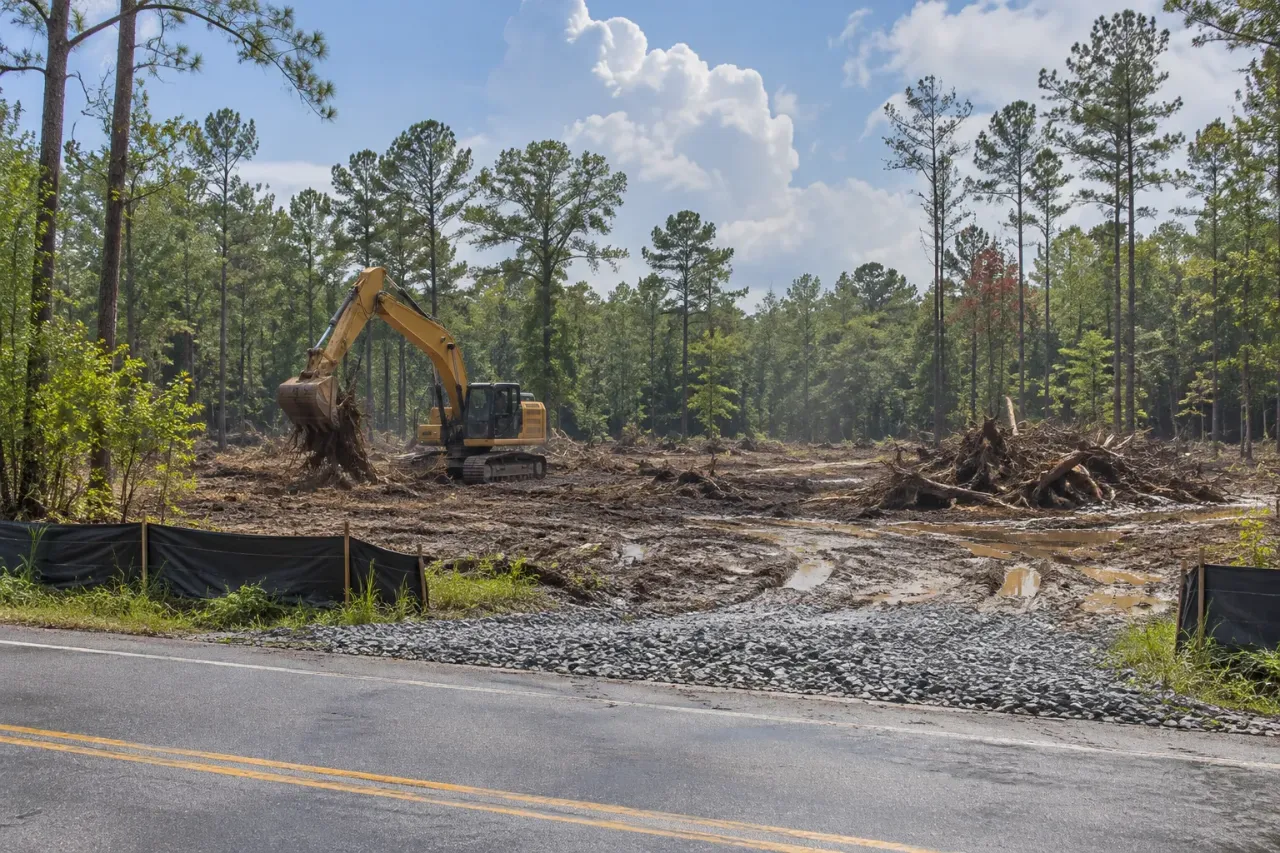
Nothing official answers it, and Suffolk's two codes read differently. City Code § 35-2 defines land disturbance as a change to the land surface that may cause erosion or change runoff, "including construction activity such as the clearing, grading, excavating, or filling of land." The Unified Development Ordinance goes further: "any change in or reconfiguration of the land surface or vegetation on the land surface through vegetation clearing or earth moving activities." Under that wording, mulching more than 2,500 square feet in the Preservation Area may well count. Ask Public Works Engineering before a big job, and get the answer in writing if you can. And inside the 100-foot RPA buffer, removing vegetation needs Planning approval no matter how it's done.
The 100-foot RPA buffer
This is the rule that catches waterfront owners. The city's guidance is blunt: "Removal of trees, shrubs, or groundcover within the RPA buffer is only allowed if approved by the City of Suffolk Planning Division." Under the ordinance and the state Bay Act regulation (9VAC25-830-140), vegetation may be removed, with approval, for reasonable sight lines and vistas, access paths, general woodlot management, and best management practices. Dead, diseased, or dying trees and noxious weeds like Johnson grass, kudzu, and multiflora rose can come out, and thinning is allowed as the city permits.
The buffer isn't only along tidal water. The city's list of Resource Protection Area water bodies includes its drinking-water reservoirs, Lake Prince, Lake Burnt Mills, Western Branch Reservoir, Lake Meade, Lake Cohoon, Lake Kilby, Speights Run, and Lone Star Lakes, along with creeks such as the Nansemond River, Chuckatuck Creek, and Bennett Creek. A lot that backs up to one of those lakes carries the same 100-foot buffer as a riverfront lot.
- Replacement is required. Anything removed has to be replaced "with other vegetation that is equally effective in preventing erosion and removing pollutants." Even when the removal is invasive plants, the city says the buffer must be replanted according to the state's riparian buffer manual.
- Building stays out. New development goes outside the 100-foot buffer. Sheds, garages, pools, and patios must be outside it too. Lots recorded before October 1, 1989 can ask for a minimal encroachment, but never into the seaward 50 feet.
- Land disturbance in the RPA needs a Water Quality Impact Assessment, minor or major depending on how much ground and how close to the water.
- Forestry is exempt if it follows the Department of Forestry's water quality practices. Farming has its own buffer rules. And when farming or forestry stops and the land is converted to another use, the full 100-foot buffer has to be re-established.
Clearing a waterfront or creek lot walks through what that looks like in practice. Not sure whether your trees are in the buffer? Planning, 757-514-4060.
Tidal wetlands and the Suffolk Wetlands Board
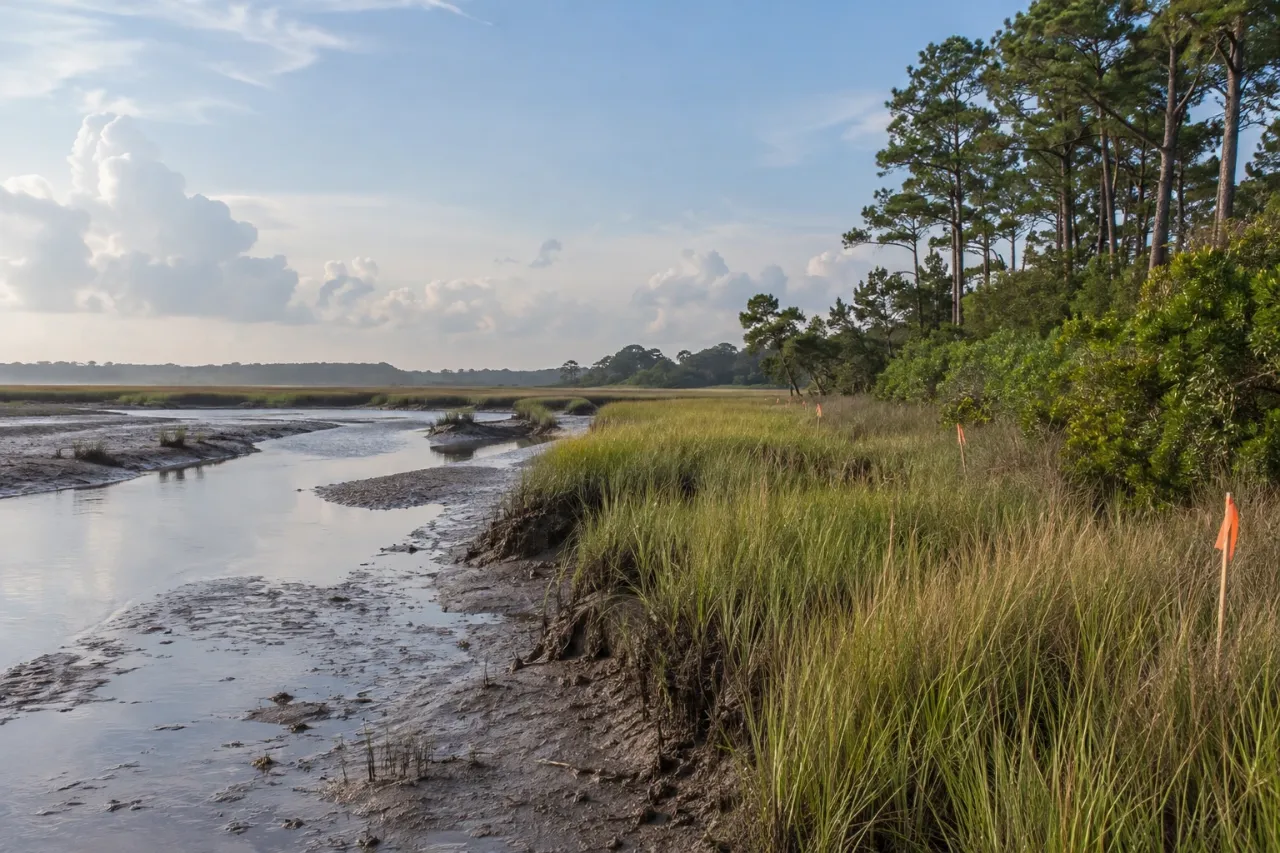
Tidal marsh, like the salt marsh along the Nansemond River, is regulated by the seven-member Suffolk Wetlands Board, with the Virginia Marine Resources Commission reviewing its decisions. Anyone who wants to "use or develop any wetland" in the city files first (City Code § 34-321), with exceptions that include grazing, haying, and harvesting agricultural and forestry products. Vegetated tidal wetlands reach up to one and a half times the mean tide range above mean low water. The city lists two different fee schedules: its permitting page says $250 for projects that go to a public hearing and $300 after the fact, while its Wetlands Board review page says $262.50 and $315. Confirm the current fee with Planning. Permits are usually good for a year. Applications start with the Joint Permit Application, which since September 2025 is filed through the Army Corps of Engineers' online Regulatory Request System. Non-tidal wetlands are regulated by the Army Corps and DEQ.
Burning: Suffolk's calendar
Suffolk is strict about smoke, and two separate rules stack up:
- No open burning May through September. City Code § 38-110(e) bans open burning and air curtain incinerators in May, June, July, August, and September. Separately, Suffolk is in DEQ's Hampton Roads emissions control area (9VAC5-20-206), where the state also bans burning clearing debris May 1 through September 30 (9VAC5-130-40).
- October through April, with a permit. Land-clearing debris (stumps, wood, brush, and leaves from clearing) can be burned only with a permit from the Fire Official, with the number and size of piles approved, at least 500 feet from any occupied building unless its occupants agree, with an attendant at all times, and only when the wind is blowing away from built-up areas. No demolition material. An air curtain incinerator needs its own permit, sits at least 300 feet from occupied buildings, and requires pulpwood, sawlogs, and firewood to be removed first.
- February 15 to April 30, Virginia's 4 PM Burning Law also bans burning before 4 PM within 300 feet of woods or dry grass. The city page says no burning of any type before 4 PM in that window.
Violations are Class 1 misdemeanors. Burn permits come from the Fire Marshal's office, the Fire Prevention Bureau, at (757) 514-4540 or fireprevbureau@suffolkva.us, and must be kept on site (city burning page). In practice, a clearing job between May and September gets mulched, ground, or hauled.
Septic systems in the Preservation Area
Inside the Preservation Area, every private septic system has to be pumped out (or inspected) at least once every five years, and new construction needs a reserve drainfield area as large as the primary one (city pump-out program). The city says properties outside the Preservation Area, in southern Suffolk, don't need the pump-out. Septic permits come from the Virginia Department of Health's Western Tidewater Health District, whose Suffolk office is at 135 Hall Avenue (757-514-4700). Because the reserve area has to stay usable, keep clearing equipment off both the primary and reserve drainfield sites.
Trees, development, and the other stream buffer
We didn't find a general city permit for cutting trees on an existing lot. Suffolk's tree canopy and landscaping rules (UDO § 31-603) apply to new major subdivisions and commercial, office, and industrial site plans. For those, the city asks that existing trees within 20 feet of water and wetlands be kept where possible, and that removed vegetation be replaced. A second stream buffer in UDO § 31-615, separate from the Bay Act, applies a 100-foot corridor along mapped streams for development. In a subdivision, no land preparation may start before the land disturbance permit. Forestry is a by-right use in almost every zoning district.
Flood zones
If any of your land is in a FEMA flood zone, Suffolk's floodplain overlay district (Section 31-416.2 of the Unified Development Ordinance) requires a city zoning permit for development there, and the ordinance counts grading and fill as development. Clearing alone isn't named. If the plan includes grading, fill, a driveway, or a building on low ground, ask Planning (757-514-4060) or Community Development (757-514-4150) before the work starts. The city's fee schedule for 2026–27 lists a zoning permit at $49.
Timber
If a logger buys the timber, Virginia law (Va. Code § 10.1-1181.2) makes the logger notify the Department of Forestry within three working days of starting a commercial harvest. Virginia's seed tree law (§ 10.1-1164) applies when loblolly or white pine is cut commercially from ten acres or more where those pines are a quarter or more of the live trees: at least eight cone-bearing pines 14 inches or larger have to be left on each acre. The exemptions in § 10.1-1163 include clearing for bona fide agriculture or improved pasture, subdividing for building sites (with homes under way within two years), land zoned for more intensive use than agriculture or forestry, and an approved forest plan. Clearing land after logging covers how these fit together.
Permit questions
Do I need a permit to grind a stump or cut a few trees in my yard?
Generally not, unless the trees are in the RPA buffer. Grinding a few stumps and taking down a few trees stays far under 2,500 square feet of disturbance, and we didn't find a general tree permit for existing lots. Near tidal water or a year-round stream, call Planning first.
Who pulls the permit, me or the contractor?
The single-family agreement is signed by the owner, and a certified Responsible Land Disturber has to be named. Contractors often handle the paperwork and can serve as the RLD. Put in writing who does what. Burn permits go to whoever is burning.
Can I burn brush in the summer?
No. No open burning of any kind in Suffolk from May 1 through September 30, under both city code and state rules. Mulch it, grind it, haul it, or use Public Works bulk pickup (757-514-7630) for yard debris.
What happens if I clear without a permit?
The city can issue a notice to comply and then a stop work order, require repairs, and in the buffer, require replanting. Willful or negligent violations of Chapter 35 can mean fines from $2,500 to $32,500. A phone call first costs nothing.
How we help
Call or send a short request, and mention if the land is near water. We connect you with one independent contractor who works in your part of Suffolk. They walk the land and give you a quote, and you decide. There's no charge for the referral. This page is general information, not legal advice; the city has the final word on its rules.
Want a local contractor to walk your land?
Call or send a short request. There's no charge for the referral.